
If you’ve ever used fitness apps like Fitbod, Strong, or Jefit, you’ve likely encountered the term “1RM” in your training programs. This mysterious acronym appears in workout calculators, strength assessments, and programming recommendations, yet many fitness enthusiasts remain unclear about what it means and how to apply it.
Whether you’re a seasoned gym-goer or someone trying to maintain fitness routines while traveling, understanding 1RM is crucial for effective training and optimal results.
What is a 1 Rep Max (1RM)?
A one-rep max (1RM) represents the maximum weight a person can lift for one complete repetition of a specific exercise. For instance, if you can bench press 225 lbs (102 kg) for one complete rep but fail at 230 lbs (104 kg), your bench press 1RM is 225 lbs (102 kg).

This metric serves as a standard benchmark for assessing absolute strength, particularly in powerlifting. However, the benefits of knowing your 1RM extend far beyond pure strength training, making it valuable for anyone serious about their fitness journey.
How Does 1RM Work?
The most straightforward method to determine your 1RM involves testing how much weight you can lift for a single repetition. This approach requires proper preparation, adequate warm-up, and ideally a spotter for safety, especially when attempting maximum loads.
However, directly testing your 1RM isn’t always practical or safe. A safer alternative involves estimating your 1RM using submaximal loads. If lifting a heavy single feels intimidating or risky, you can lift lighter weights for multiple repetitions and calculate your projected 1RM.
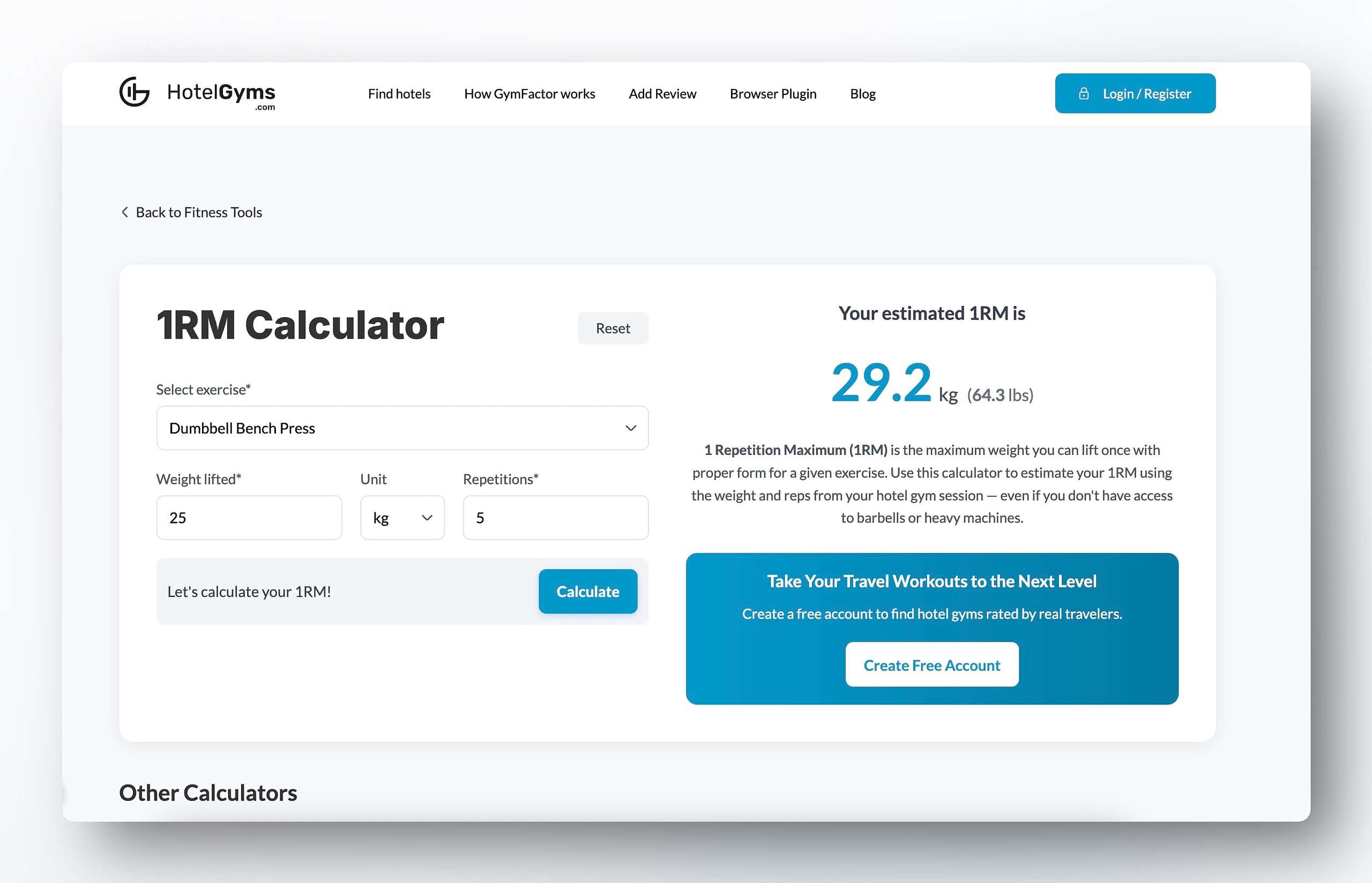
For example, if you can do a dumbbell press with 55 lbs (25 kg) for five reps, this would put your estimated 1RM at approximately 64.3 lbs (29.2 kg). Formulas developed by researchers like Epley or Brzycki can help with these calculations, or you can use our 1RM calculator tool, which simplifies the process by requiring only the weight lifted and number of reps completed.
How to Use Your 1RM in Training
Understanding your 1RM provides the foundation for calculating appropriate training loads across different goals. This becomes particularly valuable when following structured strength programs.
In daily undulating periodization (DUP), where training intensity varies from workout to workout, percentages might look like this:
- 80% of 1RM on Monday for 5 sets of 5 reps
- 85% of 1RM on Wednesday for 5 sets of 3 reps
- 70% of 1RM on Friday for 4 sets of 8 reps
You can also use 1RM percentages to target specific adaptations:
- 50 to 60% of 1RM for muscular endurance
- 60 to 80% of 1RM for muscle growth (hypertrophy)
- 80 to 95% of 1RM for maximum strength development
Beyond programming, knowing your 1RM enables you to monitor strength progress over time, set realistic goals for each training cycle, and identify potential imbalances that could affect long-term development. For example, if your deadlift significantly exceeds your back squat, this might indicate technical issues or the need to focus more attention on squatting patterns.
Why 1RM Matters When Traveling
Travel presents unique challenges for maintaining fitness routines. Hotel gyms often have limited equipment, unfamiliar machines, and weights that may not match your home gym setup. This is where understanding your 1RM becomes invaluable for travel fitness.
When you know your 1RM, you can quickly adapt to any gym environment by calculating appropriate loads regardless of available equipment. If your home gym uses pounds but the hotel gym only has kilograms, you can convert your 1RM percentages accordingly (1 kg = 2.2 lbs). If the heaviest dumbbell available is lighter than your usual training weight, you can adjust by increasing repetitions while maintaining the same relative intensity.
Understanding 1RM also helps you make the most of limited gym access during travel. Instead of skipping workouts due to unfamiliar equipment, you can modify your routine using the same intensity principles. A quick assessment of available weights allows you to determine which exercises will provide the most effective stimulus within the constraints of your temporary training environment.
For business travelers or vacation fitness enthusiasts, this knowledge transforms any basic gym into a viable training space. You can maintain your strength and muscle mass by working within appropriate intensity ranges, even when your usual routine isn’t possible.
Making 1RM Practical with Our Calculator
To help you apply these concepts, we’ve developed a 1RM calculator that takes the guesswork out of determining your maximum strength levels. Simply input the weight you lifted and the number of repetitions you completed, and the calculator provides your estimated 1RM along with suggested training loads for different goals.
This tool becomes especially useful when traveling, as you can quickly determine appropriate weights for any new gym environment. Whether you’re dealing with different weight increments, unfamiliar equipment, or limited options, the calculator helps you maintain training consistency regardless of location.
Conclusion
While constantly testing your 1RM isn’t necessary or recommended, understanding this concept and using it to guide your training decisions can significantly improve your results. For travelers who want to maintain their fitness routines across different environments, 1RM knowledge provides the flexibility to adapt any workout to available equipment while maintaining training effectiveness.
The key is using 1RM as a tool for consistent, progressive training that adapts to any situation, not obsessing over the numbers. Whether you’re at your home gym or in a hotel fitness center halfway around the world, understanding your strength levels empowers you to make the most of every workout opportunity.
Try our 1RM calculator and explore our hotel gym guides to maintain your fitness routine wherever your travels take you.