
Summer is quickly approaching, and many of us are already planning vacations or considering how to make the most of the warmer months. If building your summer physique is on your agenda, the time to start is now. But what happens when business travel disrupts your workout routine?
For travelers staying in hotels without gym access, push-ups offer an effective solution. In this comprehensive guide, we’ll explore the world of push-ups, sharing their numerous benefits and detailing various push-up variations you can perform anywhere. Ready to master the push-up? Keep reading!
What Muscles do Push-ups Target?
While often considered primarily a chest exercise, push-ups actually engage multiple muscle groups. A standard push-up targets the chest, shoulders, triceps, and core muscles, helping you not only look good but feel more confident. The illustration below highlights the main muscle groups involved in a standard push-up in red.
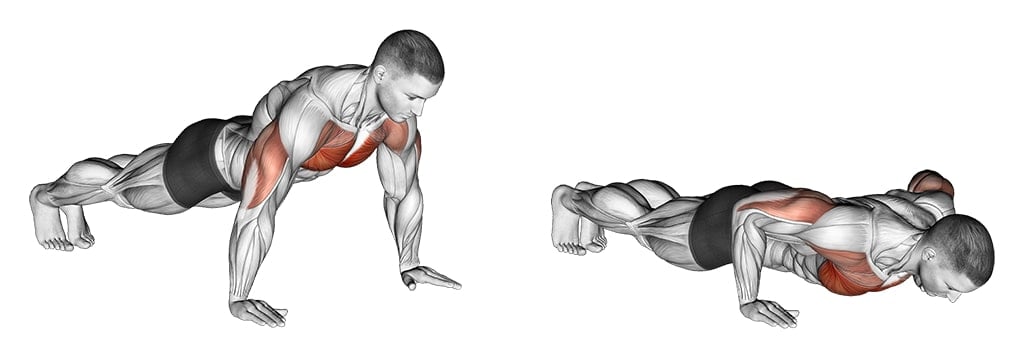
Different push-up variations engage different muscle groups:
- Wall push-ups primarily work the arms, shoulders, and chest
- Standard push-ups strengthen the chest, shoulders, and back muscles
- Narrow push-ups focus on the triceps and chest muscles
- Elevated push-ups engage the shoulders, upper back, and triceps
In essence, push-ups target several upper body muscles, allowing consistent practitioners to build strength and sculpt their physique. By adjusting your body angle and stance width, you can emphasize different muscle groups. For optimal development, incorporating several push-up variations into your routine is recommended.
Push-Up Variations for Every Fitness Level
Push-ups come in several variations, each with unique benefits. If you’re new to push-ups, mastering the standard form before attempting other variations is advisable. The variation you choose should align with your current strength, experience, and capabilities.
The good news is that push-ups have a low barrier to entry, with modifications available for all fitness levels. If standard push-ups are too challenging, begin with wall push-ups or kneeling push-ups. When standard push-ups become too easy, explore these common variations:
- Wide push-up
- Narrow push-up
- Elevated push-up
Standard Push-up
The standard push-up begins in a plank position with extended legs, knees off the floor. Keep your head neutral by looking at the floor, and position your hands directly under your shoulders. Maintain a straight back, engage your core, and ensure your hips remain level.
Muscles worked: Arms, shoulders, chest, and serratus anterior.
Wide Push-up
The wide push-up differs slightly from the standard version by increasing the distance between your hands, which intensifies chest muscle engagement. Start in a plank position, but place your hands wider than shoulder-width. Your elbows will point outward as you bend your arms.
Muscles worked: Chest, shoulders, and back muscles.
Narrow Push-up
Narrow push-ups are typically more challenging than standard push-ups as they reduce the distance between your hands, increasing the workload on your arm muscles. Begin in a plank position with your hands placed closer together, directly below your chest. Your elbows should tuck into your body as you bend and straighten your arms.
Muscles worked: Triceps and chest muscles.
Elevated Push-up
The elevated push-up raises your feet above your body, requiring greater strength to maintain proper form. Start in a plank position, then elevate your lower body by placing your toes on a stable surface like a bench, box, or chair. Position your hands beneath your shoulders with arms straight.
Muscles worked: Shoulders, upper back, and triceps.
The Benefits of Push-ups
When it comes to staying fit (or getting in shape), push-ups are arguably one of the most effective exercises, not only for their accessibility but for their versatility and efficiency. Push-ups are ideal for building your summer body whether you’re traveling, at the beach, or in your hotel room.
Push-ups provide a powerful full-body workout, using significant energy to lift and lower much of your body weight in a short time. Beyond muscle development, push-ups improve balance, posture, and flexibility.
In essence, push-ups require minimal or no equipment, making them perfect for hotel room or at-home workouts. With numerous variations available to accommodate different strength levels and abilities, they’re an excellent exercise option for travelers. Let’s explore how to get started.
How to Master the Push-Up
Before learning proper push-up technique, it’s important to understand common mistakes to avoid:
- Placing your hands too far forward
- Dropping your hips
- Flaring your elbows
- Not controlling the downward and upward movements
Tips for Proper Form
Performing push-ups with incorrect form can lead to injury. Proper technique helps prevent lower back and shoulder pain. If a particular push-up variation feels too difficult, modify it to match your current fitness level.
For proper push-up form:
- Keep your back straight and core engaged
- Position your hips in line with your body, not lifted
- Maintain a straight line from head to heels, avoiding back arching
- Never allow your body to sag
Ask a workout partner to check your form or record yourself to ensure proper technique.
Equipment to Enhance Your Push-ups: Push-Up Handles
Push-up handles aren’t just fancy push-up bars. They are your ticket to chest day. The rotating platforms follow your natural arm movement, reducing wrist strain from standard push-ups on hotel carpet. Push-up handles can help:
- Increase range of motion for deeper push-ups
- Reduce wrist pain and pressure
- Activate more muscle fibers through the increased depth
- Provide stability on uneven hotel room floors
- Add variety to your travel workout routine
For frequent travelers committed to maintaining their fitness regimen, these handles are a worthwhile addition to your luggage.
Step-by-Step Guide for Mastering the Standard Push-up
Instruction only goes so far. Taking action is what matters most. If you’re learning push-ups independently, consider using a fitness app like Fitbod to track your progress, or record yourself to review and correct your form.
- Begin in a classic plank position with arms shoulder-width apart
- Fully extend your legs with your body completely aligned
- Tuck your elbows at a 45-degree angle, with palms under your shoulders
- Breathe in. Engage your core and glutes, then bend your elbows to lower your chest as close to the floor as possible
- Pause for 1 second
- Breathe out. Straighten your arms to lift your body back to the starting plank position
- Repeat
By maintaining a neutral spine, engaging your core, creating a stable base through your hands, and controlling each repetition, you’ll be well on your way to mastering the standard push-up!
How Many Reps?
The ideal number of repetitions depends on factors including age, gender, and fitness level. A practical approach is to perform as many push-ups as possible in two minutes, then divide that number by three. For example, if you complete 36 push-ups in two minutes, aim for three sets of 12 push-ups with two-minute rest periods between sets.
The Canadian Society for Exercise Physiology has established push-up performance norms with categories ranging from “needs improvement” to “excellent,” which can provide helpful benchmarks. Another reference point is the U.S. Air Force physical fitness test, which requires male recruits to perform at least 33 push-ups and female recruits at least 18 push-ups in one minute.
While some people attempt to perform as many push-ups as possible until exhaustion, this approach isn’t recommended for daily exercise as it may lead to burnout or injury.
In Summary
Whether you’re a beginner or fitness enthusiast, push-ups are an excellent exercise when performed safely and effectively, both during travel and at home.
When moving from hotel to hotel, you’ll likely encounter varying equipment availability. In these situations, push-ups provide a valuable and effective exercise option. To maintain consistency during your travels, consider using a fitness app like Fitbod. This tool helps you track your progress and stay accountable, even when you’re on the road.