
Many travelers assume that hotel price and facility quality go hand in hand, gyms included. That assumption is understandable, but it’s wrong. There is no reliable correlation between what you pay for a room and what you’ll find in the fitness center.
This post breaks down why that gap exists, what actually drives gym quality, and how to find a hotel that takes fitness seriously before you book.
Why Budget Hotels Usually Don’t Invest in Their Gyms
To understand the gap, start with what a typical hotel gym actually looks like. For the most part, it’s a small room with a handful of machines: a treadmill or two, a stationary bike, and an elliptical if you’re lucky. For weights, you might find a few pairs of lighter dumbbells, a cable machine, and occasionally a short bar with some plates.
Budget hotels rarely invest beyond that baseline. The reasoning is straightforward from a business perspective: hotel operators assume most guests don’t prioritize the gym, and that a poor fitness facility isn’t a deal-breaker for the majority of their customers. That assumption shapes every square-meter decision they make.
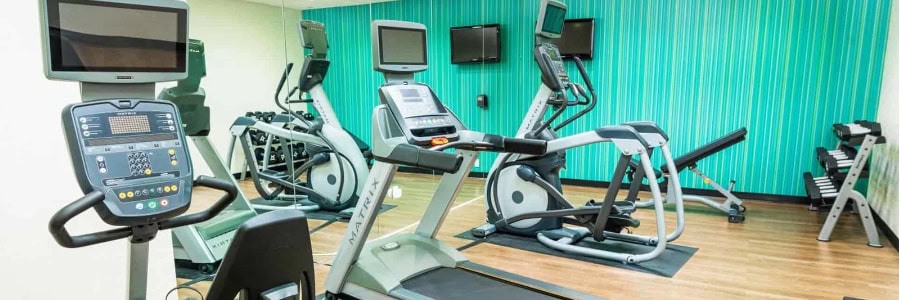
It also comes down to revenue math. A gym takes up space that could otherwise house an additional room, a bar, or a restaurant, all of which generate direct income. Gyms, by contrast, are included in the stay. They’re expensive to equip, require ongoing maintenance, and produce no measurable revenue on their own. For a budget property optimizing every corner of its footprint, a minimal gym is a rational outcome.
When a Budget Hotel Does Have a Good Gym (And Why)
Budget hotels can have good gyms. It happens. But it’s the exception, and it’s almost always tied to who the hotel is built for.
The clearest signal is the target guest. Hotels that serve business travelers and extended-stay guests have a direct incentive to maintain a functional gym, because those guests use it regularly and factor it into their booking decisions. Hotels that position themselves around active travel, using terms like “wellness-friendly” or “fit lifestyle” in their branding, tend to back that positioning with real investment in the facility.
A useful mental model: if a hotel is known as a work-travel property, expect at least a serviceable gym. If it’s an active lifestyle hotel, the gym will likely be well-equipped. If it’s a generic budget property with no particular fitness angle, don’t expect much beyond a treadmill in a small room.
Why Expensive Hotels Can Also Have Terrible Gyms
The inverse problem is equally real. Premium hotels frequently advertise their gyms as state-of-the-art, with polished photos and descriptions to match. The reality, too often, falls well short.
HotelGyms.com has received direct reports from travelers who booked specifically on the strength of a hotel’s gym marketing, only to arrive at a facility that bore no resemblance to what was advertised. One case illustrates the problem clearly: a four-star hotel in Washington lists a fitness center across its booking platform profiles, including a note on Booking.com stating a partnership with a nearby gym. In practice, the staff on-site had no knowledge of that partnership, and guests were expected to pay for a day pass out of pocket. The hotel had not invested in guest fitness. It had invested in appearing as though it had.
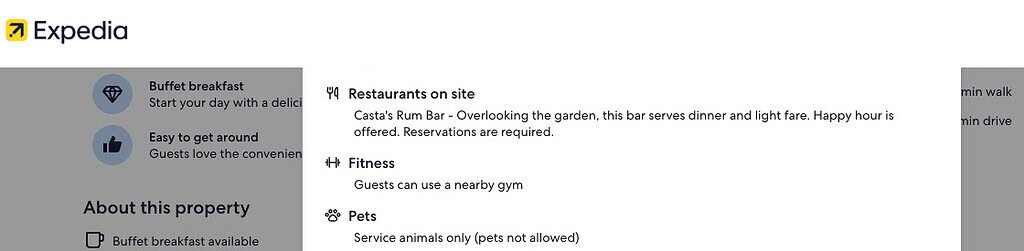
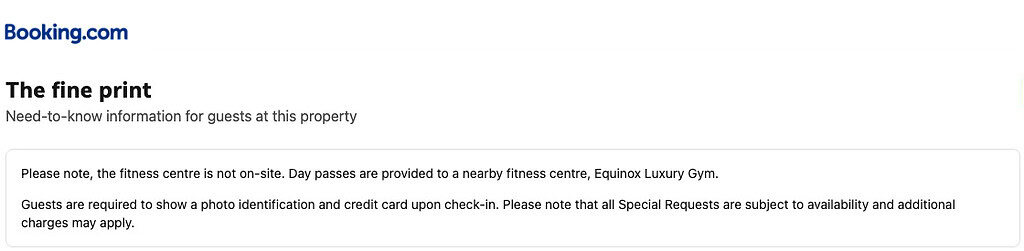
The underlying cause is the same one driving budget hotels to underinvest. Hotels across all price tiers are incentivized to maximize revenue-generating floor space: bars, restaurants, spas. A gym doesn’t generate extra revenue, and it’s difficult for hotel owners to quantify its impact on booking decisions.
The result is that many hotels invest just enough to check the box of “has a gym,” then do little in the way of maintenance or upgrades beyond that. Premium pricing does not change that calculation. It just comes with better photos.
The Smart Way to Choose a Hotel
Price alone is not a useful filter for gym quality. That means a different approach is needed.
Start by stopping reliance on promotional images, marketing descriptions, and reviews that may have been curated or paid for. These are often designed to create an impression, not to inform a decision.
Instead, look for information that actually tells you what’s in the gym:
- Is the equipment listed in detail, including specific machines and weight options?
- Are there photos from actual guests, not the hotel’s own marketing materials?
- What are the opening hours?
- How much usable floor space is available?
- Is there any indication of how well the facility is maintained and cleaned?
GymFactor cuts through this directly. It scores hotel gyms on training usefulness, not price tier or hotel class. The score is based on concrete factors: available equipment, weight options, condition, free space, opening hours, and more. The result is an objective, comparable signal you can use across budget, mid-range, and premium properties.
Before your next trip, check the GymFactor score for your hotel on HotelGyms.com. It takes 30 seconds and tells you exactly what to expect from the gym before you arrive.
Conclusion
Budget hotels can have good gyms. Expensive hotels can have bad ones. Price is not the variable that determines gym quality, and trusting marketing material will leave you walking into a room with one treadmill and no weights.
If staying fit on the road matters to you, do the research before you book. Install the GYMR browser extension to get GymFactor scores directly on hotel booking sites, so you have objective data at the moment you’re making the decision.